Insignia
From The Archive, the curated record of the world of Insignia
Glyphs of light that bind a name to a person or place
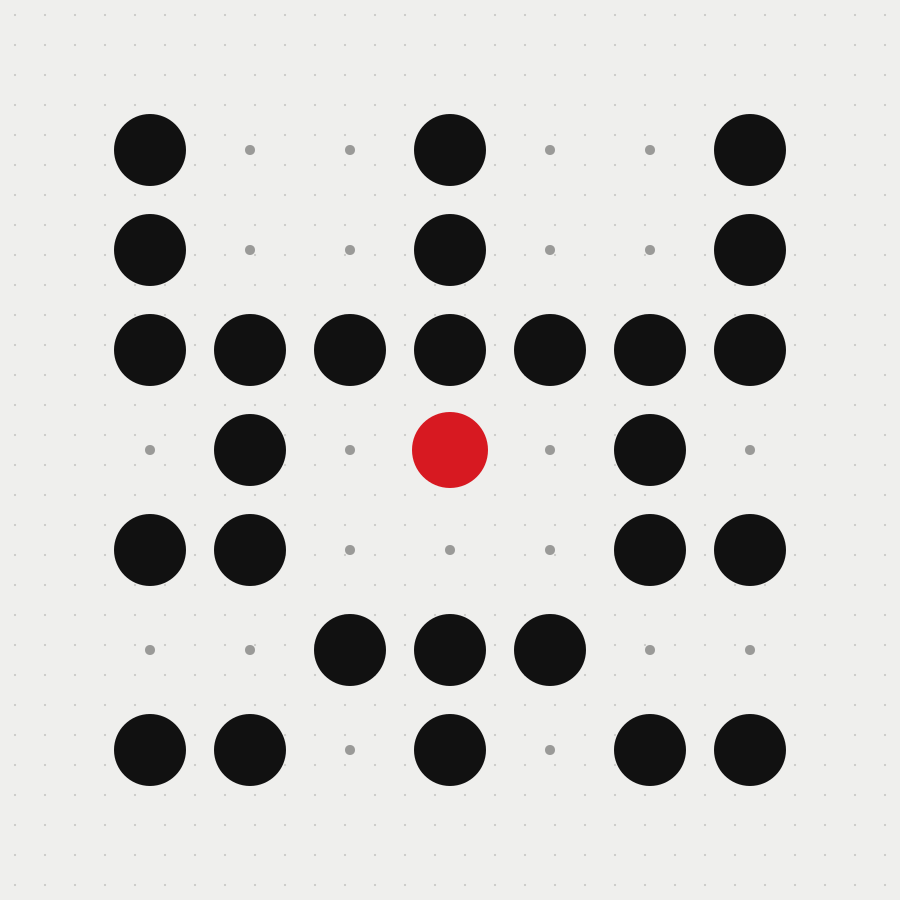
A reconstructed insignia on the standard seven-by-seven grid, after guild records | |
| Overview | |
|---|---|
| Type | Light-glyph |
| Grid | 7 × 7 points |
| Carried by | Pylons |
| Read by | Lantern Guild |
| History | |
| First recorded | c. 900 BD |
| Last broadcast | The Dimming, 0 PD |
An insignia is a glyph of light, broadcast from a pylon, that binds a name to the person or place that receives it. For most of recorded history, to bear an insignia was to be remembered: property, kinship and debt were kept in light rather than in ink.1 Since the Dimming no new insignia have been broadcast, and the surviving ones are slowly fading from the people who carry them.
Etymology
The word is borrowed from an older ceremonial language in which it meant “that which is set upon”. Early guild records use it only for the glyphs set upon places — a hill, a well, a crossing — and it is only from around 400 BD that it is used for people.
Description
An insignia is composed on a grid of seven by seven points. Each point is either lit or dark, and every glyph is mirror-symmetric about its vertical axis, which leaves 28 meaningful points and a little over 268 million possible glyphs. The centre point is always lit. Readers call it the hearth.

Reading
Reading an insignia is less like reading a word than like recognising a face. Trained readers of the Lantern Guild describe the glyph “arriving all at once”. Untrained people see only a pattern of dots, though most can tell their own insignia from any other at a glance.2
Carrying
A received insignia persists as a faint afterimage that the bearer can recall at will, and that others can read when it is recalled in front of them. It is not visible in ordinary light.
Loss
After the Dimming, insignia began to fade from their bearers at a rate of roughly one point per generation. The first point to fade is never the hearth. Families in Halden keep painted copies of their insignia on the lintels of their doors so that children can learn the full glyph before their own copy thins.
In culture
Insignia appear on doors, in lullabies and in the grammar of the city. “To go dark” is to be forgotten; “an unlit name” is a polite phrase for a stranger. The seven-point grid is also the basis of most of the region’s textile patterns.
See also
- Pylon — the towers that broadcast insignia
- Glyph grammar — the rules for composing a valid glyph
- Ines Varo — a guild reader who studies fading glyphs
References
-
Lantern Guild, The Book of Lamps, folio 12. ↑
-
Ines Varo, field notes, 212 PD. Quoted in the novel The Quiet Signal. ↑
Appearances
This entry appears in the following works:
- Gallery Hearth — Digital study
- Gallery Seven in a Line — Notebook page
Linked from: Halden · Ines Varo · Lantern Guild · Pylon · The Dimming
| The world of Insignia | |
|---|---|
| Concepts |
|
| Places | |
| Organizations | |
| People | |
| Events | |